The Committee
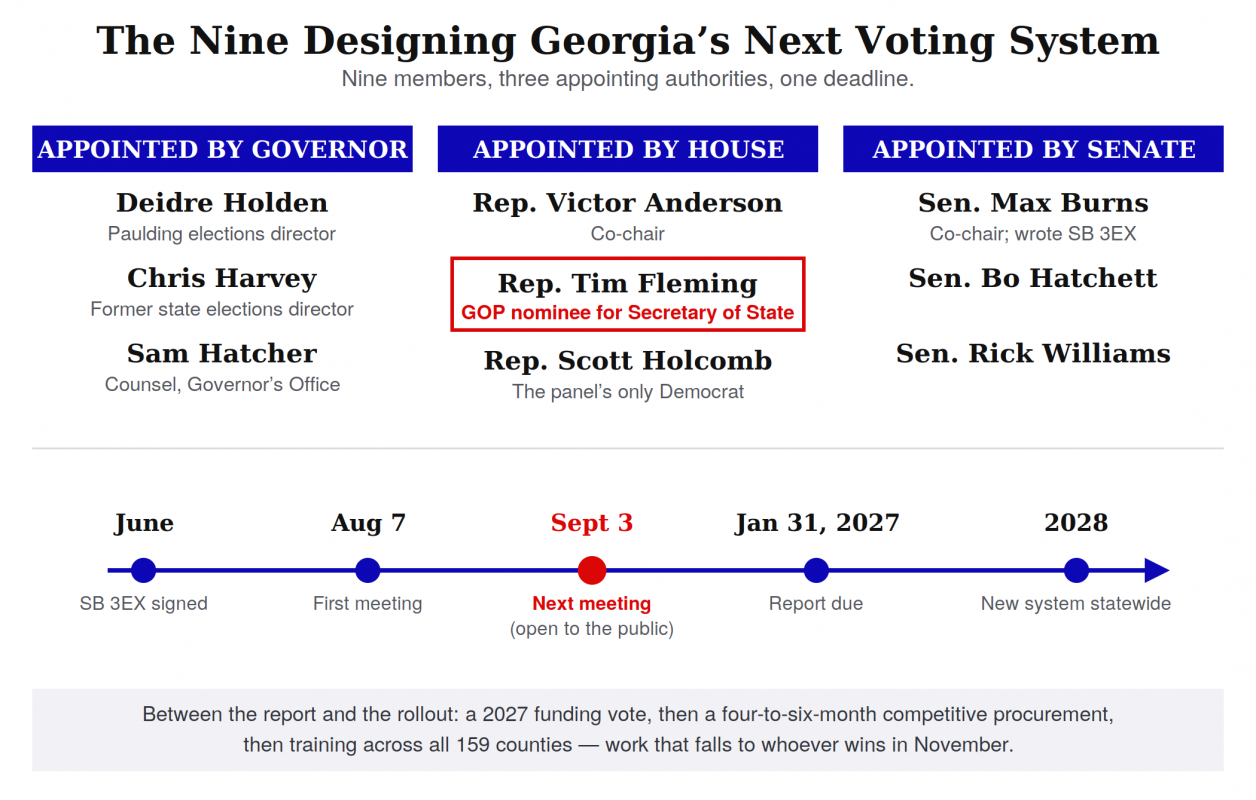
Tim Fleming, GOP Nominee for Secretary of State, Is on the Committee Defining the New System
|
|
|
|
|
Senate Bill 3EX created the Election Equipment Specifications and Standards Committee in June. Its mission, in the bill’s own words:
|
|
By January 31, 2027, the committee shall prepare a report which shall provide its recommendations for specifications, standards, and requirements for a new uniform system of election equipment … of sufficient detail so as to allow legislative and executive policymakers to develop appropriations, procurement, and implementation plans … for use … in the 2028 election cycle. The report shall be delivered to the Governor, the Lieutenant Governor, the Speaker of the House of Representatives, the Secretary of State, and the State Election Board.
|
| |
|
|
|
Fleming’s seat offers something transitions rarely get: the official who implements the blueprint helped draft it. That continuity arrives only if he wins in November. If his Democratic opponent, Penny Brown Reynolds, wins, the plan lands on the desk of someone who had no hand in drafting it.
And I’m pleased to see Deidre Holden, Paulding County’s election director, at the table — the professionals’ seat, alongside former state elections director Chris Harvey. Readers may remember Holden from our September 2025 issue, which featured her Blue Ribbon presentation on the bad DDS data flooding Georgia’s voter rolls. Now she brings that operational perspective to the system redesign.
|
| |
|
|
|
People, Process, Technology
Buying Machines Isn't Running Elections
|
|
|
|
|
The Dominion system gave Georgia uneven performance — accepted at the touchscreen, doubted at the count, neglected in the back office. That unevenness wasn’t the machine’s fault. Software and hardware by themselves do nothing; they come to life only as a service: people to run it, process to govern it, technology kept current. Georgia funded the equipment and starved the service.
Three failures tell the story:
- The updates never got installed. Dominion shipped software updates for seven years. Georgia applied none of them — a $15 million job that went unfunded year after year.
- The warning became a demonstration. Researchers flagged a security weakness in 2022; officials called it too convoluted to exploit. This month, a Princeton researcher used AI to do exactly that, matching voters to their ballots from publicly available data. No vote totals moved, and there’s no evidence anyone malicious ever tried — but ballot secrecy is a promise in Georgia’s constitution.
- The law outran the funding. The 2024 QR-code ban set a deadline and provided no money to meet it. July’s special session pushed it to 2028.
Every fix arrived the same way: reactively, after the embarrassment.
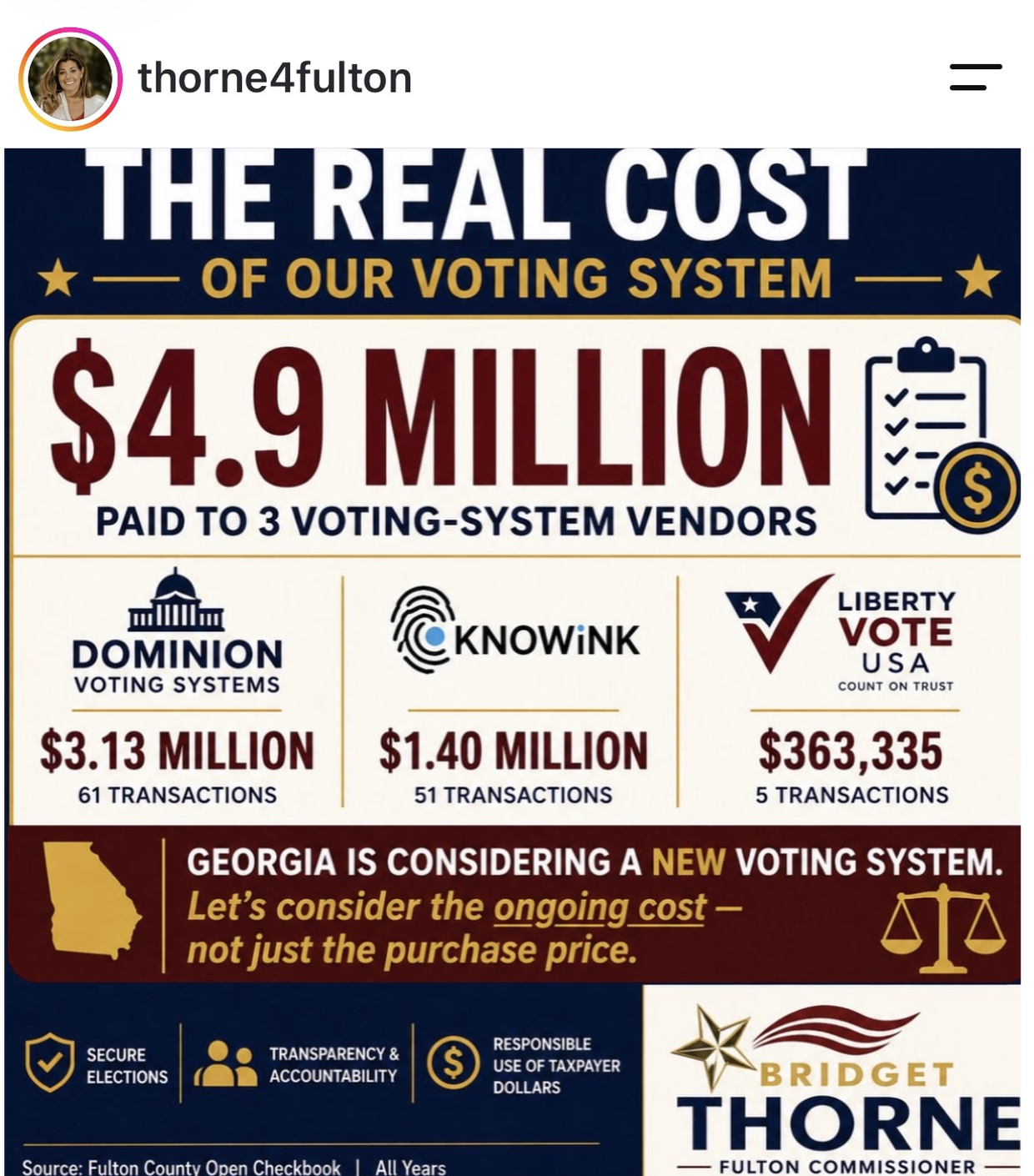
And the service carries costs the sticker never shows. Commissioner Bridget Thorne pulled Fulton’s numbers from Open Checkbook: $4.9 million to three voting-system vendors — one county’s share, and only a portion of what it costs Fulton to run elections. Her ask of lawmakers is this issue’s thesis in one line: weigh not just the purchase price, but “what taxpayers will pay to RUN it for years to come.”
|
|
|
|
|
|
|
The lesson for the committee fits in one sentence: don’t repeat the Dominion mistake by treating this as an equipment purchase. Design — and fund — the entire election service.
|
| |
|
|
|
In the AJC
At These Prices, Expect Excellence
|
|
|
|
|
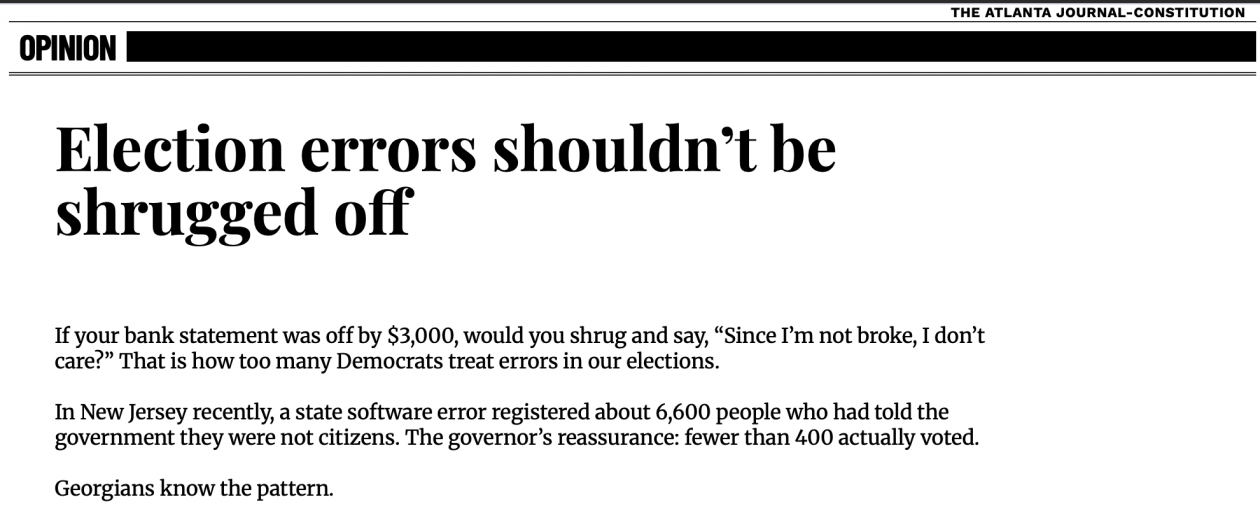
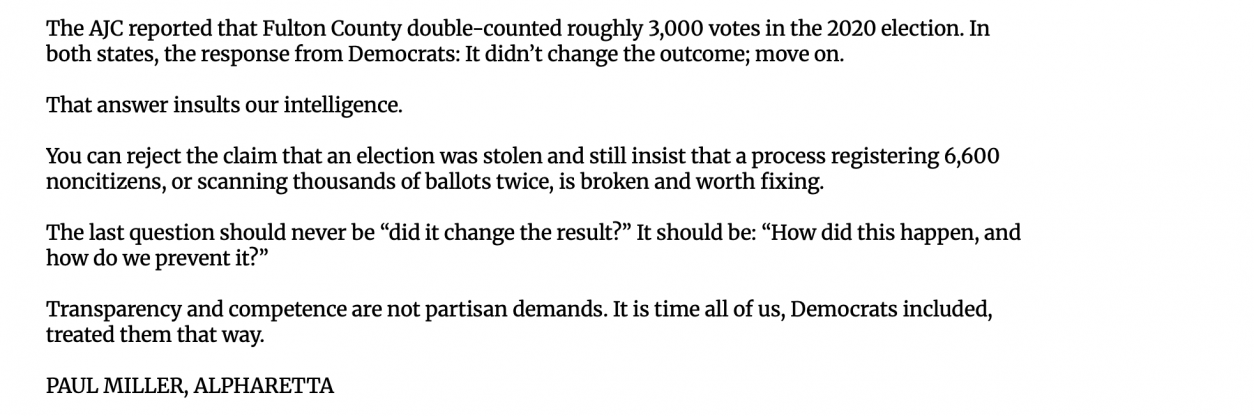
A service this expensive comes with expectations — a count that’s right, a ledger that reconciles, answers that don’t require a subpoena. No apologies for expecting excellence — and a process worth trusting is worth trusting when your side loses. Our editor made the case in the August 2 AJC:
|
| |
|
|
|
The last question should never be “did it change the result?” It should be “how did this happen, and how do we prevent it?” That is what it means to trust the process, not just the outcome — and holding the service to that expectation is exactly what comes next.
|
| |
|
|
|
An Open Letter to the Committee
Grading Georgia’s Election Service
|
|
|
|
|
To the nine members of the Election Equipment Specifications and Standards Committee:
A balanced scorecard is how serious organizations grade a service — money, experience, trust, operations, improvement. We built one for Georgia’s election service and graded the system you are replacing, using only published sources: state surveys, court records, news reporting, and this newsletter’s archive.
Georgia has done some things remarkably well. The question isn’t whether to tear everything down — it’s whether the next system can preserve those strengths while fixing the failures in stewardship. That is the question this scorecard tests.
|
| |
|
|
|
FINANCIAL — RED
Objective: The full cost of the service — purchase, updates, training, replacement — is known, budgeted, and managed
Bought, not budgeted. $15M in updates never applied since 2019; the $66M QR fix unfunded until the deadline became a crisis; Fulton’s share alone: $4.9M to three vendors per Commissioner Thorne’s Open Checkbook tally. [AJC ’26; Open Checkbook; EI News Apr ’26]
|
|
|
|
|
FINANCIAL — NOT MEASURED
Objective: Election costs — state and county — are transparent and benchmarked
Nobody measures it. Costs split between the state (machines, licenses) and 159 counties (operations); vendor spend became visible only because a commissioner dug through Open Checkbook; no published benchmark exists at either level. [Open Checkbook]
|
|
|
|
|
VOTER EXPERIENCE — GREEN
Objective: Voting is easy, fast, and safe for every voter
Georgia’s strong suit. 98% reported no problems, 94% found it easy, 81% waited under 10 minutes. [UGA ’24]
|
|
|
|
|
VOTER EXPERIENCE — GREEN
Objective: Every voter has convenient options — early, absentee, or Election Day
The trifecta. First state to combine automatic registration, 17+ days of early voting — called the “gold standard” — and no-excuse absentee. Nearly 8 in 10 voters now vote early. [UGA ’24]
|
|
|
|
|
VOTER EXPERIENCE — RED
Objective: The voter can read and verify the thing that gets counted
The QR gap. Machines tabulate a code no human can read — a practice the legislature has already outlawed effective 2028. [SB 3EX; EI News Jul ’26]
|
|
|
|
|
STAKEHOLDER TRUST — YELLOW
Objective: Voters trust the count — win or lose
Trust follows the scoreboard. Democrats 33.9% “very confident” vs. Republicans 59% after a GOP win; after 2020, the doubting side was Republican. [UGA ’24, UGA ’22]
|
|
|
|
|
STAKEHOLDER TRUST — RED
Objective: The people running the service earn trust — state stewardship and county boards seated as designed
Failed at both levels. The state: an office that let its own QR mandate die unfunded and unexecuted [EI News Apr ’26]. The county: Fulton’s commissioners defied three court orders to seat GOP nominees to the election board, choosing $10,000-a-day contempt fines over compliance. [EI News Sept ’25]
|
|
|
|
|
INTERNAL PROCESSES — YELLOW
Objective: The voter list is accurate, maintained, and challenges get transparent answers
113 for every 100. Fulton carries 113 registrations per 100 voting-age citizens (statewide: 103). Bad DDS data flows in unfiltered — a fix Paulding’s election director spelled out to the Blue Ribbon panel — and county “black box” maintenance means nobody reports what comes out. [EI News Sept ’25; US EAC]
|
|
|
|
|
INTERNAL PROCESSES — YELLOW
Objective: Counts reconcile, and discrepancies get explained
The books don't close cleanly. In 2020, recounts upheld the outcomes — and Fulton admitted double-scanning 3,000+ ballots, then withheld the records from a state subpoena for nine months. The question is “how did this happen, and how do we prevent it.” [EI News Sept ’25; AJC Letter 8/2/26]
|
|
|
|
|
INTERNAL PROCESSES — RED
Objective: Security is maintained — patches tested and applied on schedule
Seven years, zero updates. No software updates since the 2019 purchase; flagged in 2022; demonstrated by a Princeton researcher this month. [AJC ’26]
|
|
|
|
|
LEARNING AND GROWTH — RED
Objective: The service improves continuously — benchmarks, reviews, upgrades on a cadence
Reactive by design. Updates, mandates, and fixes move only when a crisis forces them. [AJC ’26; EI News Jul ’26]
|
|
|
|
|
LEARNING AND GROWTH — YELLOW
Objective: The workforce — poll workers up front, operations staff behind them — is trained and consistent
Green out front, gray in back. Voters rate their poll workers superbly (98.3%). The mishaps live where voters can’t see — double-scanned ballots, roll maintenance Fulton itself described as bare-minimum. [UGA ’24; EI News Sept ’25]
|
|
|
|
|
SOURCES CITED IN THE SCORECARD
- AJC ’26 — Caleb Groves, “Georgia passed on election upgrades. A Princeton researcher exploited weakness in system,” Atlanta Journal-Constitution, Aug. 17, 2026. ajc.com (subscription)
- AJC Letter 8/2/26 — Paul Miller, “Election errors shouldn’t be shrugged off,” letter to the editor, Atlanta Journal-Constitution, Aug. 2, 2026. ePaper edition (subscription; reprinted in full above)
- UGA ’24 — 2024 Georgia Post-Election Survey, University of Georgia School of Public and International Affairs, published by the Georgia Secretary of State, Dec. 2024. Full report (PDF)
- UGA ’22 — 2022 Georgia Voter Survey, University of Georgia School of Public and International Affairs. Summary release
- SB 3EX — Senate Bill 3EX, Georgia General Assembly, 2026 special session (committee mandate, hand-marked paper requirement, QR deadline). Official bill text
- Open Checkbook — Commissioner Bridget Thorne’s tally of Fulton County payments to voting-system vendors, drawn from the county’s Open Checkbook, Aug. 2026. Posted analysis
- US EAC — U.S. Election Assistance Commission, Election Administration and Voting Survey data. eac.gov
- EI News Sept ’25 — “Clean Rolls, Clean Elections,” Election Integrity News, September 2025 (voter-roll ratios, DDS intake, Fulton board-seat litigation). Read the issue
- EI News Apr ’26 — Election Integrity News, April 2026 (state election leadership). Read the issue
- EI News Jul ’26 — Election Integrity News, July 2026 (the QR-code mandate and the special session). Read the issue
|
| |
|
|
|
The pattern is the point: the greens belong to voters and the people who serve them face-to-face; the reds belong to money, maintenance, and governance. Georgia built an election service that’s easy to use and hard to trust when you lose. Your job is to fix the reds without breaking the greens. This scorecard is how we'll read your report when it arrives.
|
| |
|
|
|
Agree with this standard? Here’s how to be heard.
1. Send your support to the committee. Written comments are encouraged.
|
| |
|
|
|
Opens in your mail app, addressed to committee staff with a draft message with a placeholder for you to personalize. Add a sentence of your own — staff weighs personal comments far more than form letters.
2. Forward this issue to a Georgian who should see it.
3. Show up. The next meeting is Thursday, September 3, 10 a.m., Room 307, Coverdell Legislative Office Building — open to the public, with testimony from election officials and experts in cybersecurity, accessibility, and security. Three follow: September 17, October 1, and October 15; the last two focused on vendors. In-person comment is at the co-chair’s discretion and must be relevant to the committee’s work. ( Schedule · Meeting notice)
|
| |
|
|
|
The Bottom Line
The 2028 Election Is Being Designed in 2026
|
|
|
|
|
The committee recommends; elected officials deliver. The 2027 General Assembly writes the check and the next Governor signs it — Jackson or Bottoms. The next Secretary of State turns the blueprint into 159 county rollouts and thousands of retrained poll workers — Fleming or Reynolds, and one of them helped draft it. When the report lands, the scorecard above will be waiting for it.
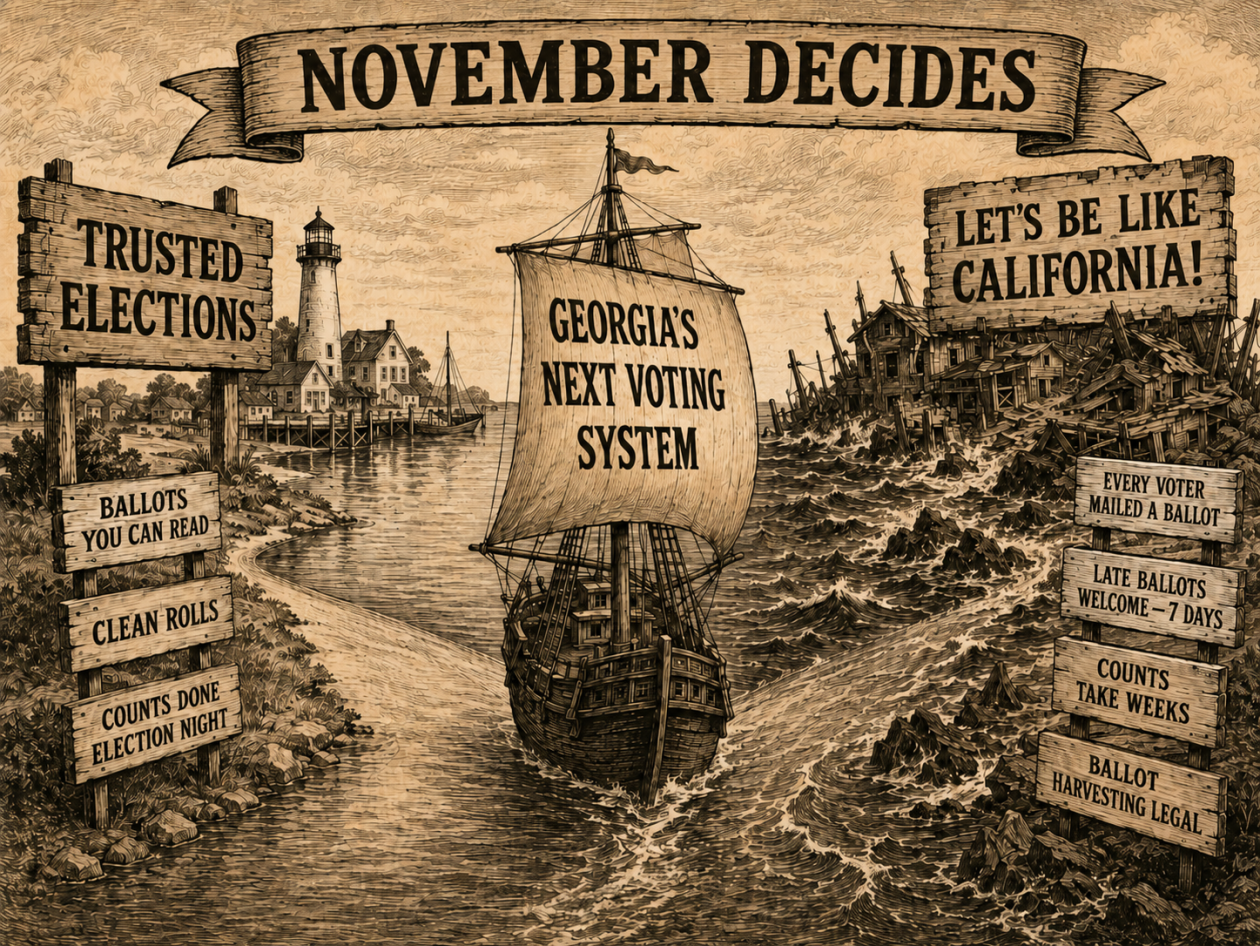
Registration for November 3 closes Monday, October 5. Early voting runs October 13–30. Make a plan to vote. The people elected this November won’t just inherit Georgia’s election system — they’ll decide what replaces it.
|
| |
|
|
|
|
|