|
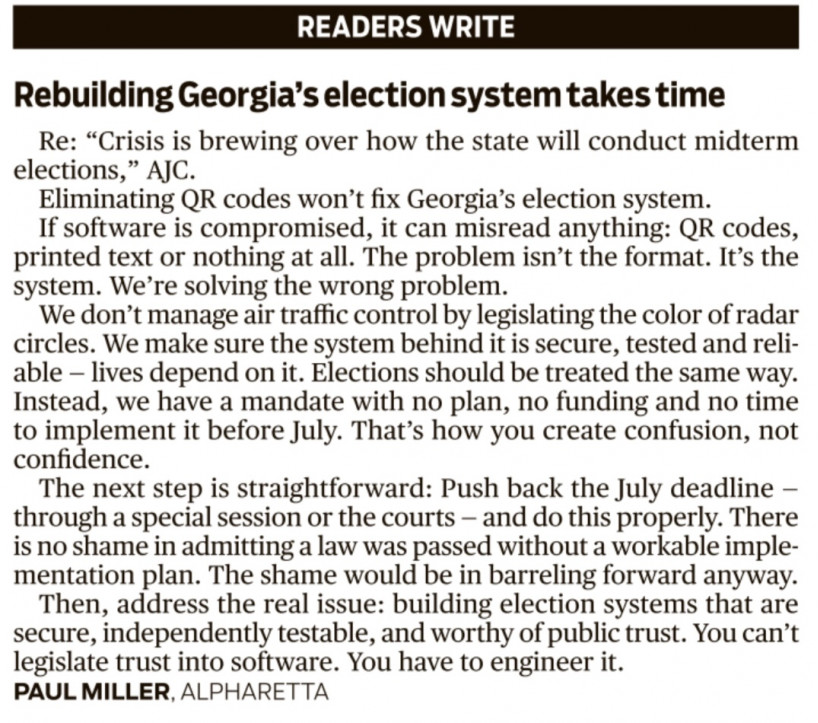
The QR Code is the Symptom, Not the Disease
|
|
|
|
|
|
The legislature’s failure was years in the making. They commissioned their own Blue-Ribbon Committee on Election Procedures, received its recommendations, and ignored them. With the July 1 deadline looming, the House passed a reasonable bipartisan bill to transition to a new system by 2028. The Senate let it die without a vote.
Now Governor Kemp faces a choice: call a special session, or let the courts determine what’s lawful after July 1. Either way, the legislature handed this to someone else to fix.
Even if Kemp calls a special session tomorrow, the calendar is brutal. Transitioning 159 counties to a new voting system — new equipment, new training, new procedures — in time for November is not a plan. It’s a gamble. Rushed technology changes don’t reduce errors. They introduce new ones. The push to fix a trust problem with QR codes risks creating a much larger trust problem with a chaotic November election.
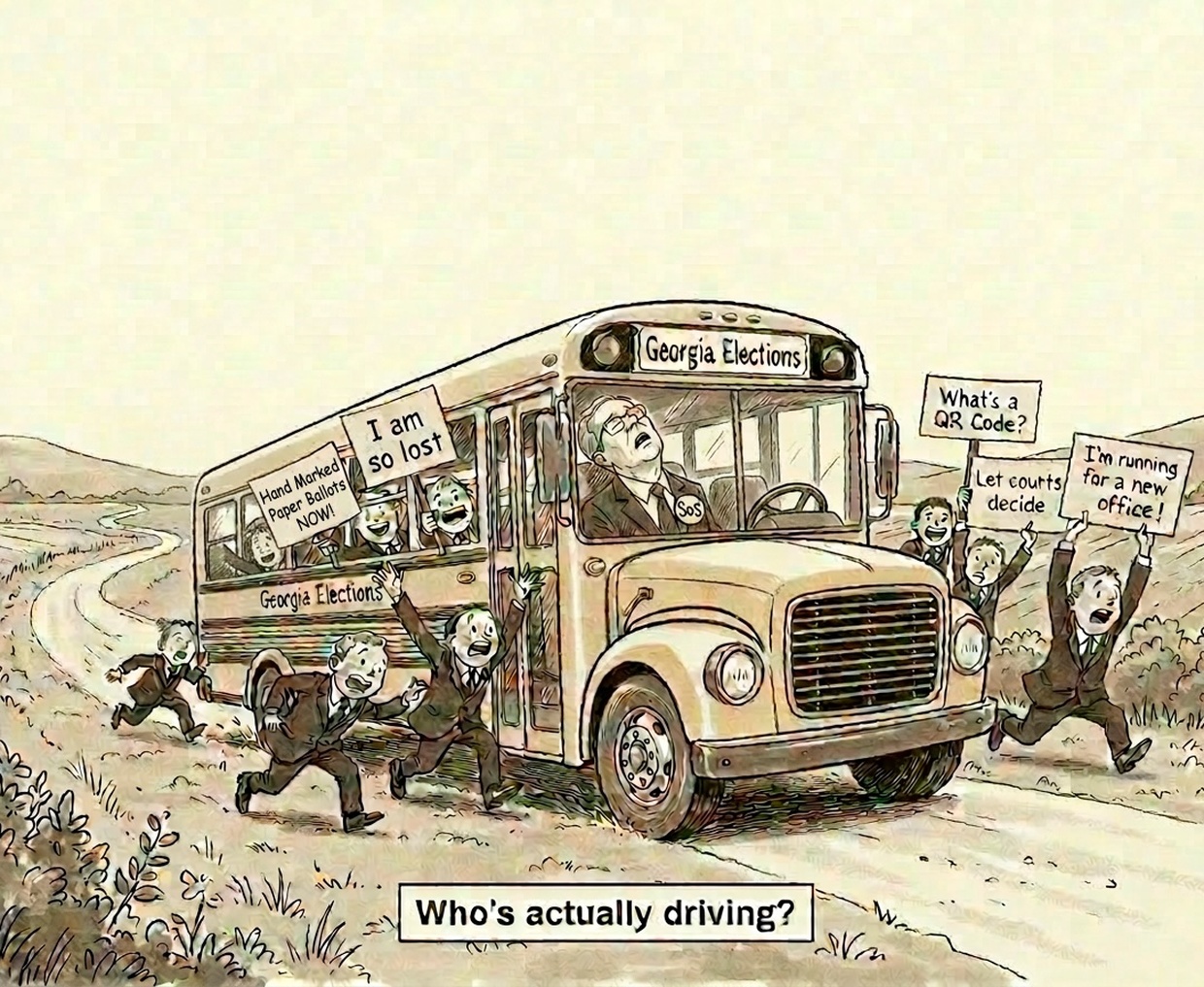
But the legislature's failure didn't happen in a vacuum. The Secretary of State, whose job is to anticipate these moments, raise the alarm early, and drive solutions, was absent from that process. An engaged SoS could have orchestrated the situation. Instead, Georgia has an empty chair.
|
|
|
|
|
|
The Empty Chair - Georgia's Secretary of State
|
|
|
|
|
|
The Secretary of State’s office is the department head for elections, whose job is to execute mandates, raise concerns early, and lead implementation.
Secretary Raffensperger has defended Georgia’s Dominion system as among the best in the nation: understandable, given he championed it and is running for Governor. Admitting a transition was needed would concede problems with a system he staked his reputation on. So he didn’t engage.
|
|
|
|
|
|
This week, the AJC pressed him directly on his own proposed workaround: optical character recognition instead of QR codes, at $300,000 per election:
|
“You’d have to ask a lawyer. I’m an engineer.”
— Brad Raffensperger, AJC, April 13, 2026
|
On the legislature’s role:
|
“They never funded anything. It’s the height of irresponsibility.”
— Brad Raffensperger, AJC, April 13, 2026
|
Both quotes are true. Together, they capture the failure: a legislature that mandated without funding, and a Secretary of State who pointed fingers without leading.
Running elections across 159 counties is genuinely hard work, and no candidate arrives with a perfect blueprint. But the question this crisis raises isn’t about perfection — it’s about engagement. Georgia needs a SoS who intends to lead while they’re there — not one focused on the next office rather than this one
|
|
|
|
|
Georgia will almost certainly resolve this — likely ugly, last-minute, and embarrassing. But it will get resolved at the state level, where it belongs.
What's worth understanding is that our system has a safety net for exactly these moments. That safety net has a name: federalism. We saw it engage right here last month when federal investigators stepped in on the 2020 election inquiry — not a takeover, but a backstop doing its job.
Part II explains the constitutional architecture behind federalism — and why the current mess is a stress test the system was built to handle.
|
|
|
|
|
|
Part 2: The Safety Net: Federalism
|
|
|
|
|
|
Federalism - When One Level Fails, Another Picks it Up
|
|
|
|
|
|
You’ve heard both parties invoke states’ rights over elections when federal involvement doesn’t suit them. The Constitution is less convenient than either side pretends. Article I gives states authority over elections, but immediately gives Congress the power to override those rules. That wasn’t an oversight. The Founders knew states could fail. This isn't a flaw in the system. It's the system.
|
|
|
|
|
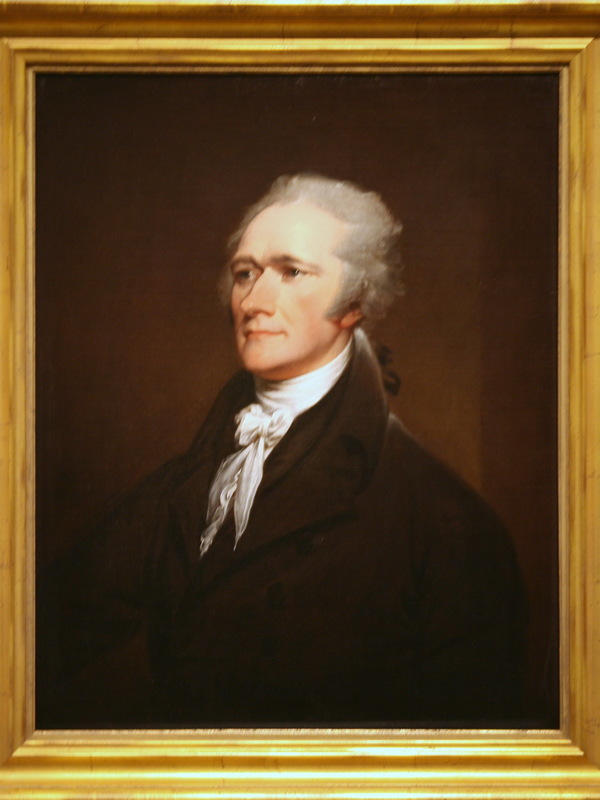
Alexander Hamilton
John Trumbull, c. 1806 |
|
|
|
In Federalist No. 59, Hamilton argued that exclusive state control was dangerous — states could manipulate or even disable the national government. The federal override was essential to the republic’s survival.
The Constitution itself was designed to be amended. Adaptive governance wasn’t an afterthought. It was the architecture.
|
|
|
|
|
|
When a state genuinely can’t manage its own affairs — as Georgia’s legislature just demonstrated, the mess gets 'kicked upstairs': courts can move and/or federal authority can engage. Messy. Slow. But federalism was designed for exactly this. It’s how it has always worked, from the very beginning.
|
|
|
|
|
|
The First Mail-in Ballot Fraud - 1864
|
|
|
|
|
|
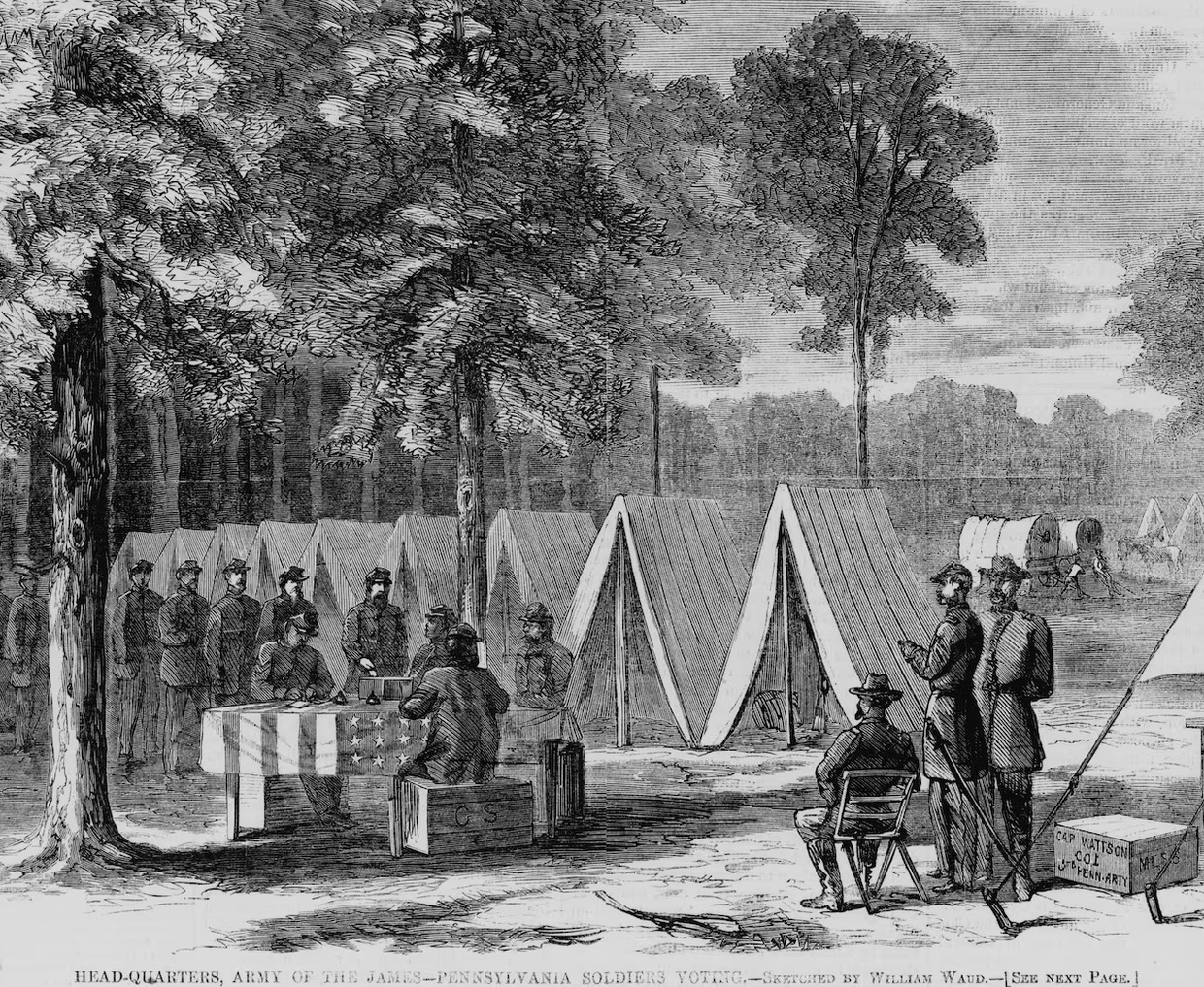
Pennsylvania soldiers voting in the field, Army of the James, 1864. Library of Congress.
|
|
|
|
|
|
In 1864, New York created its first mail-in ballot system to allow Union soldiers to vote from the front. The system was established over the objections of Governor Horatio Seymour, a Democrat who had vetoed the original mail ballot bill. Seymour then appointed the very officials who oversaw the soldier vote. Within months, Democratic operatives were forging signatures of soldiers, the wounded, and the dead: shipping crates of fraudulent ballots for Lincoln’s opponent back to New York. Seymour would later run against Ulysses Grant for president in 1868.
The scheme was uncovered. The ringleaders were tried by a military commission. Lincoln won. The conspirators went to prison.
|
|
|
|
|
|
Every new voting method creates new vulnerabilities. The system has always had to adapt — and when states couldn’t manage it alone, the federal government stepped in.
That pattern has repeated across American history. The timeline below shows how — and where we are today.
|
|
|
|
|
|
A History of Reacting to Crisis
|
|
|
|
|
Crisis:
Southern states systematically blocked Black voters through poll taxes, literacy tests, and intimidation. State-level failure was total and entrenched.
|
|
|
Response:
Congress passed the Voting Rights Act, establishing federal enforcement authority and requiring federal oversight of elections in states with a history of discrimination. The most enduring federal election reform ever enacted. |
|
|
|
|
|
1993 Motor Voter Act (NVRA)
|
|
|
|
|
Crisis:
Voter registration rates were low and fragmented across 50 states, with no consistent process or form.
|
|
|
Response:
Congress passed the National Voter Registration Act, requiring states to offer voter registration at DMV offices and public assistance agencies, and establishing a standardized national registration form accepted in all states. Voter registration rates increased significantly as a result. |
|
|
|
|
|
2002 Help America Vote Act (HAVA)
|
|
|
|
|
Crisis:
Florida 2000. Hanging chads. No consistent standards for ballots, voting machines, or vote-counting across counties or states.
|
|
|
Response:
Congress invested $3 billion to replace punch card and lever voting machines nationwide, required states to establish centralized voter registration databases, and created the Election Assistance Commission (EAC) as a permanent federal resource for election administration. The EAC provides guidance and distributes funding — but was deliberately given no binding regulatory authority. It can recommend. It cannot require. |
|
|
|
|
|
2020 Covid and Mail Ballots
|
|
|
|
|
Crisis:
The pandemic forced a rapid mass expansion of mail voting. States improvised with no consistent national standards for ballot deadlines, signature verification, or chain of custody.
|
|
|
Response:
Congress provided emergency funding to states through the HAVA grant program to help manage the transition. No durable national standards were established. Each state continued under its own rules, leaving the underlying inconsistencies unresolved. |
|
|
|
|
Crisis:
No reliable national system exists to verify voter citizenship at the point of registration. States rely on self-attestation under penalty of perjury, creating a trust gap.
|
|
|
Response:
The House passed a proof-of-citizenship requirement — the right goal. But without a federal citizenship verification infrastructure that states can rely on, the mandate produces 50 different implementations with uneven enforcement. Currently stalled in the Senate. The infrastructure needs to be built before the requirement can work. |
|
|
|
|
|
2026 Mail-in Ballot Deadlines
|
|
|
|
|
Crisis:
14 states allow mail ballots to be counted days or weeks after Election Day, creating uncertainty, results that shift after election night, and eroding public trust in outcomes.
|
|
|
Response:
The Supreme Court is expected to rule by late June that federal law requires all ballots to arrive by Election Day — establishing a national standard where none existed. A federal backstop is in motion exactly as designed. |
|
|
|
|
|
Better governance models exist.
The FAA works differently — it investigates failures and learns from them, but it also proactively sets standards, certifies new technology, and updates requirements as aviation evolves. It doesn't wait for a crash to ask whether the new aircraft is safe. Election governance needs that same dual orientation: the ability to respond when things go wrong, and the professional infrastructure to anticipate before they do.
That's a conversation Georgia can no longer afford to postpone — and it starts with who sits in the Secretary of State's chair next January.
|
|
|
|
|
|
Part 3: Federalism in Action - Right Now
|
|
|
|
|
National Standards for Mail-in Ballot Deadlines -
What Should Actually Happen |
|
|
|
|
|
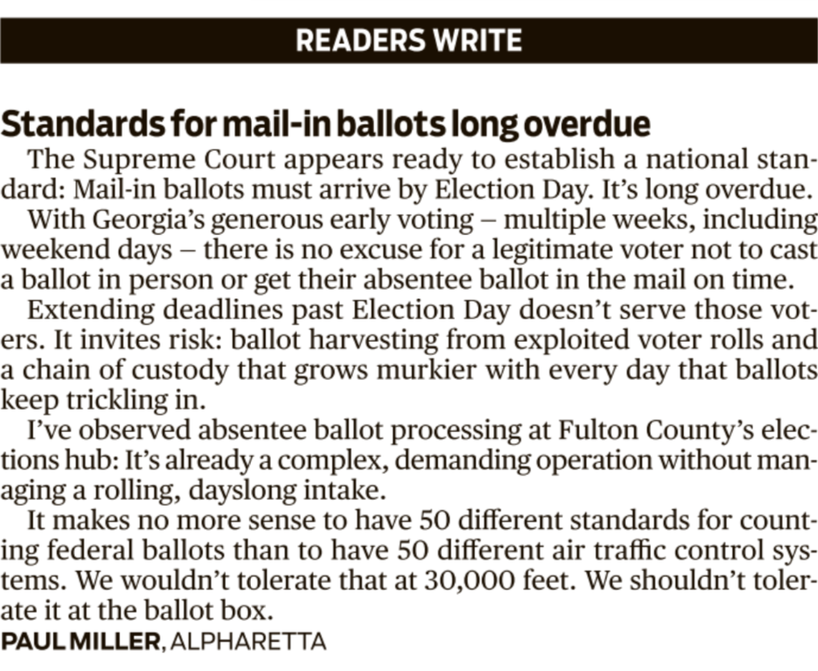
Watson v. Republican National Committee is now before the Supreme Court — a direct consequence of Congress’s failure in 2020 to establish any national standard for mail ballot deadlines. Fourteen states have been counting ballots arriving days or even weeks after Election Day. The conservative justices appear ready to end that — ruling that ballots must arrive by Election Day, with a decision expected by late June in time for November’s midterms.
This is federalism doing exactly what it was designed to do: a state-level failure that Congress never resolved, handed up to the constitutional backstop.
|
|
|
|
|
|
Paul Miller, AJC — “Standards for mail-in ballots long overdue.” March 31, 2026
|
|
|
|
|
|
Georgia's QR Code Crisis - What Should Actually Happen
|
|
|
|
|
Removing QR codes from Georgia ballots won't make the election system more secure. Think of it this way: if you don't trust Publix's checkout system, the answer isn't to rip out the bar code scanners and make cashiers read the printed text on every product. Scanning printed text is actually more error-prone than scanning a bar code. You haven't fixed anything.
And here's what Publix gets right that Georgia's voting system doesn't: you get a receipt. You can see exactly what you paid for and verify it yourself. With Georgia's current system — QR code or no QR code — there's no equivalent. The voter has no way to confirm that what the machine recorded matches what they intended. That's the black box problem. And that's why this crisis runs much deeper than QR codes.
The real issue is trustworthiness — and that has to be built into the system, not legislated around the edges. That's where hand-marked paper ballots come in. When a voter marks their own ballot and can read it before submitting, they have their receipt. And critically, because that ballot is human-readable, it can be audited and hand-counted independently of any machine. The scanner no longer gets the last word. That's what closes the black box — and that's the right North Star for Georgia.
Florida got there — and is now widely regarded as the gold standard in U.S. election administration. But Florida didn’t get there in ten weeks. After the 2000 hanging chad disaster, it spent more than two decades methodically rebuilding its entire election system — with funding, sequencing, and engaged leadership at every step. |
|
|
|
|
|
|
Florida Election Reform Act signed. Punch cards banned. New standards enacted. Five months after the crisis.
|
|
|
|
|
|
|
New optical scan systems operational statewide. Two years after the crisis.
|
|
|
|
|
|
|
Legislature requires all paper ballots to be hand-marked marksense ballots. Five years after the crisis.
|
|
|
|
|
|
|
Ballot Marking Devices introduced for voters with disabilities, as required by federal law — a touchscreen that prints a human-readable paper ballot that the voter verifies before submitting. Nearly twenty years after the crisis.
|
|
|
|
|
Georgia's goal — a system that produces a voter-verified paper ballot — is worth pursuing. Florida proves it's achievable. But Florida also proves it takes time, money, and genuine leadership to do it right. Rushing 159 counties through a technology transition with no plan, no funding, and a ten-week runway doesn't get Georgia to Florida. It gets Georgia to chaos.
Which brings us to the most consequential question on Georgia's ballot this fall: who leads Georgia's elections next — and can they set a North Star for where Georgia needs to go, then actually lead us there? |
|
|
|
|
|
Part 4: The Race that Decides How Georgia Runs its Elections
|
|
|
|
|
|
Who Becomes Georgia's Next Secretary of State?
|
|
|
|
|
|
The QR code crisis, the July 1 deadline, the 159 counties without a lawful path forward — whoever wins the Secretary of State’s race inherits all of it. This is the department head for Georgia elections. Someone has to set a North Star and lead us there. Five Republicans are on the May 19 primary ballot:
|
|
|
|
|
Tim Fleming
State Rep., D-114 |
|
|
Vernon Jones
Former State Rep. |
|
|
Kelvin King
Business Owner |
|
|
Ted Metz
Retired Fin. Planner |
|
|
Gabriel Sterling
Former SoS COO |
|
|
|
|
The question isn’t just where each candidate stands on QR codes. It’s whether they understand that this role demands a North Star and the operational discipline to pursue it — not just political positioning.
🎬 Watch the debate: Atlanta Press Club / Georgia Public Broadcasting, April 28 |
|
|
|
|
|
Everything described in this newsletter — the crises, the responses, the backstops — happens in the background. What happens in the foreground is up to you. An informed voter who shows up is the most powerful force in this system. Watch the debate. Know the candidates. Get to the polls on May 19.
|
|
|
|
|
|
|