Inform ★ Engage ★ Empower
July 2026
|
|
|
|
|
What the Runoff Answered
Experience Won
|
|
|
|
|
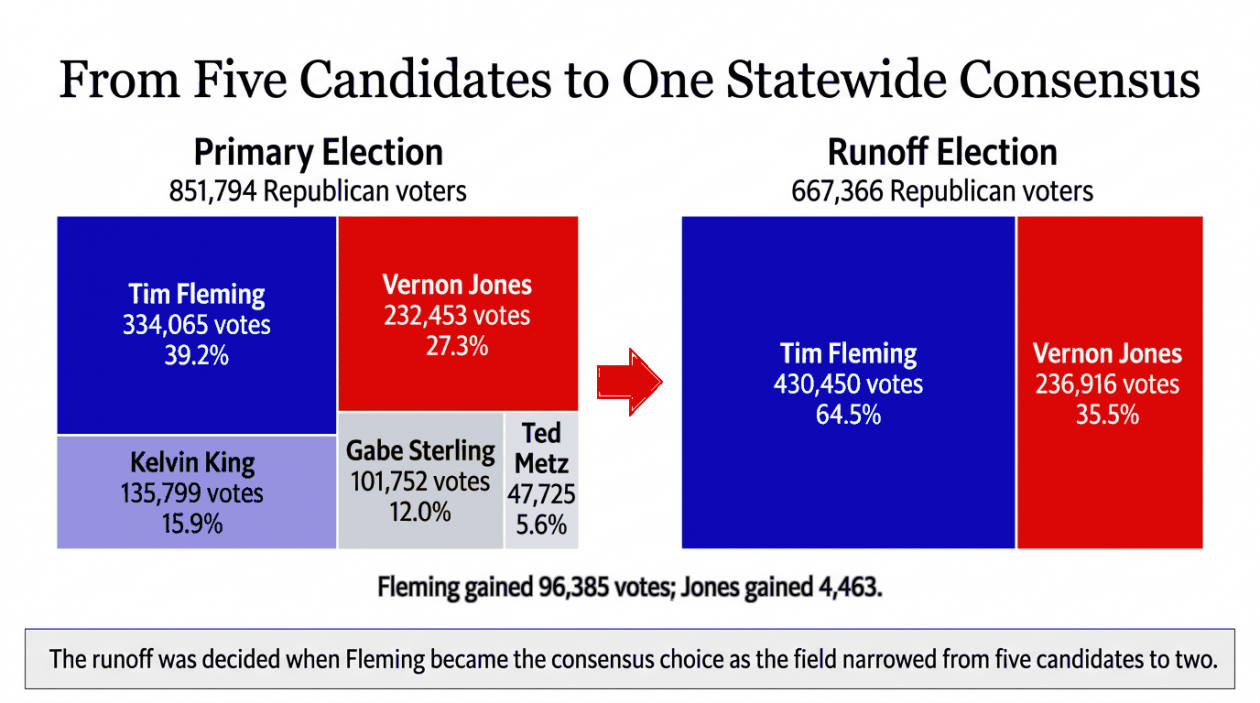
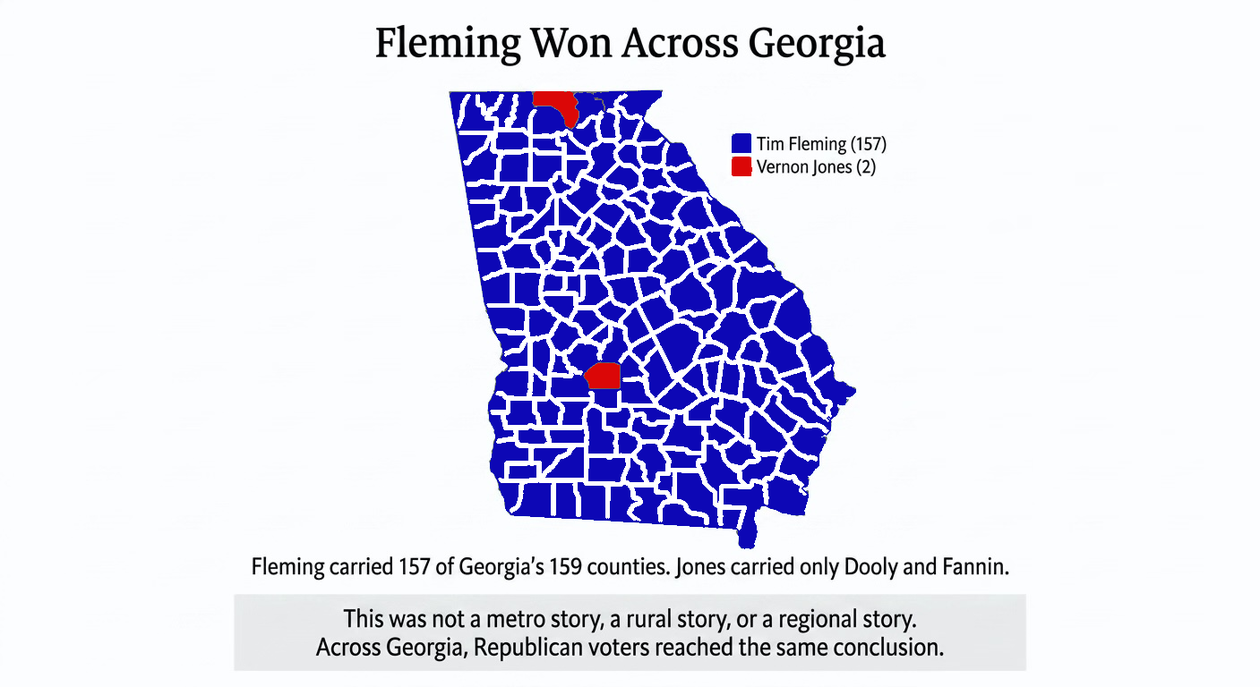
On June 16, Republican voters answered the question five candidates left open in May — and they answered it decisively. Tim Fleming is the nominee for Secretary of State, winning the runoff 64.5% to 35.5% in a result few expected to be this lopsided.
The margin is the headline — but the mechanics are the story. A five-way field collapsed into a single statewide consensus, turnout defied the usual runoff falloff, and the numbers send signals worth reading closely — because the office on November’s ballot has rarely mattered more.
Last month, we published a forecast for how this runoff might break. This issue takes stock: three findings from the returns, an honest look at where our forecast missed — and why the miss is good news — and the stakes now riding on the seat Fleming just won the right to contest.
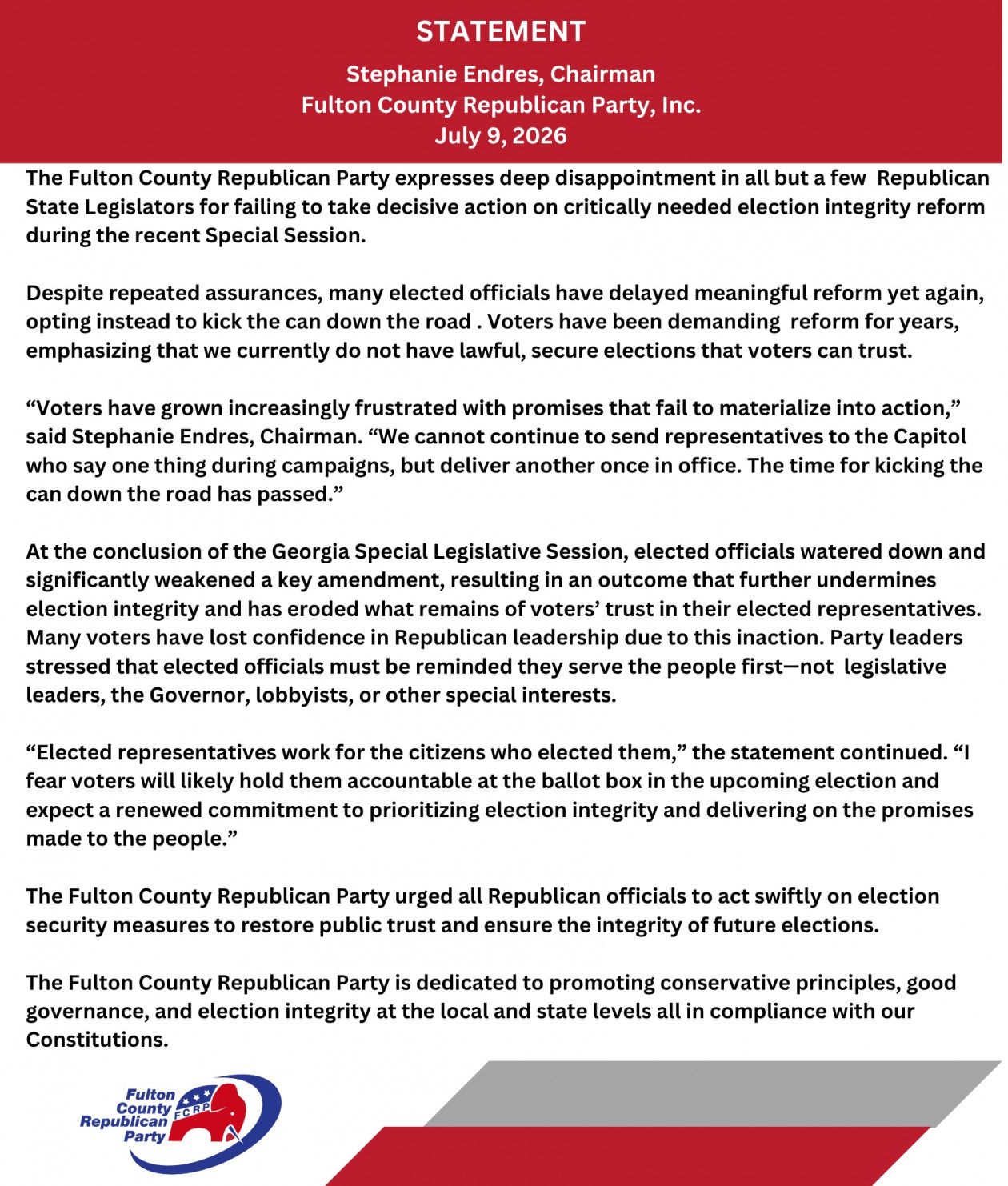
This month, we also include a message from FCRP Chairman Stephanie Endres on the special session.
|
| |
|
|
|
Editor-in-Chief
Paul Miller is a Fulton County resident who has served as a poll worker, poll watcher, deputy registrar, and observer in Fulton County elections. A retired technology and business leader, he brings a practical perspective shaped by firsthand experience.
|
| |
|
|
|
🗳️ Fulton County GOP Election Integrity Leadership Team
Team Lead: Kevin Muldowney | BRE Liaison: Kevin Muldowney |
Poll Watchers: Steve Smith | Poll Workers: Lucia Frazier & Melissa Fioriollo |
Newsletter: Paul Miller | Design: Adrianne Miller
|
| |
|
|
|
|
|
The Results
What the Runoff Showed
|
|
|
|
|
We built a county-by-county Election Forensics workbook using official results, so readers can inspect the numbers behind this analysis.
|
|
|
|
|
Testing Our June Model
We Missed, and the Miss Favors the GOP
|
|
|
|
|
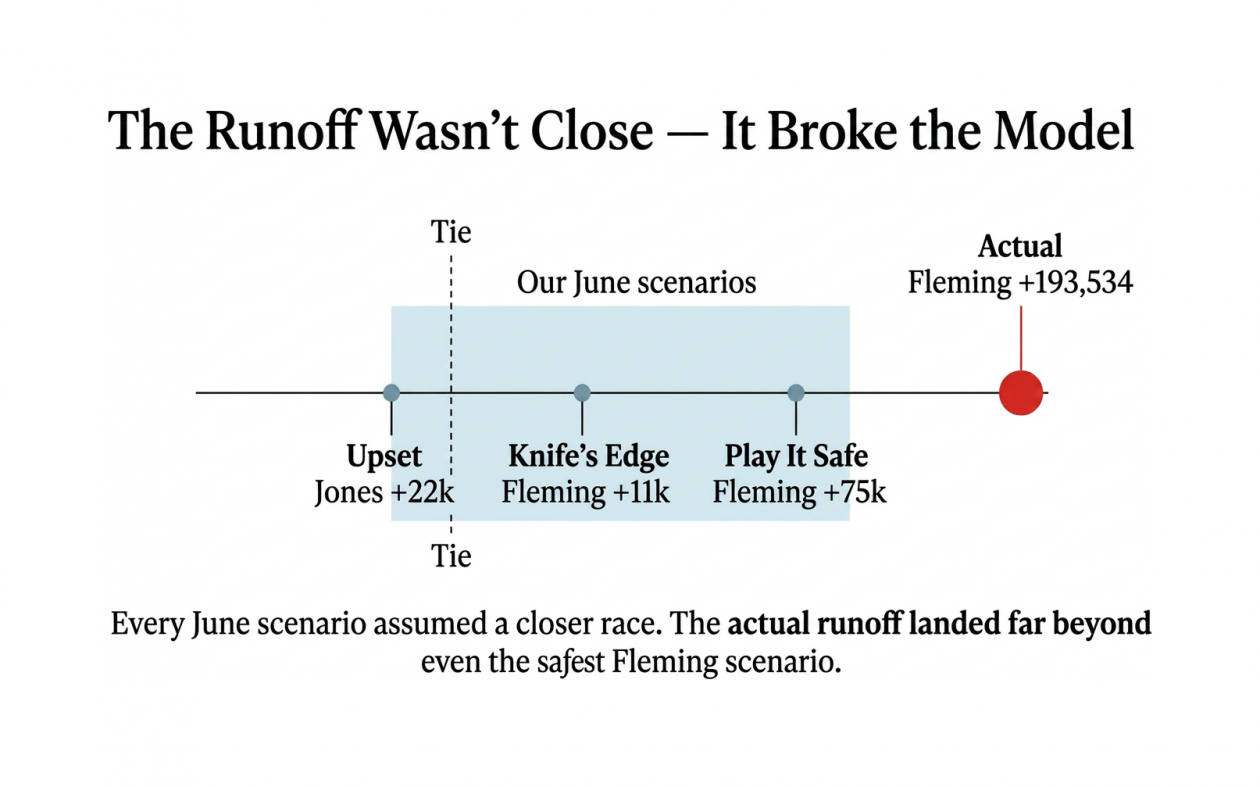
Our June scenario model warned that the Combat bloc’s discipline could close the gap — that a motivated base might outrun a complacent front-runner. That is not what happened. Fleming won by a wider margin than even our most Fleming-friendly scenario projected, and the two assumptions behind our caution both broke the same way: toward a stronger, more unified GOP.
|
| |
|
|
|
Turnout blew past our modeled ceiling.
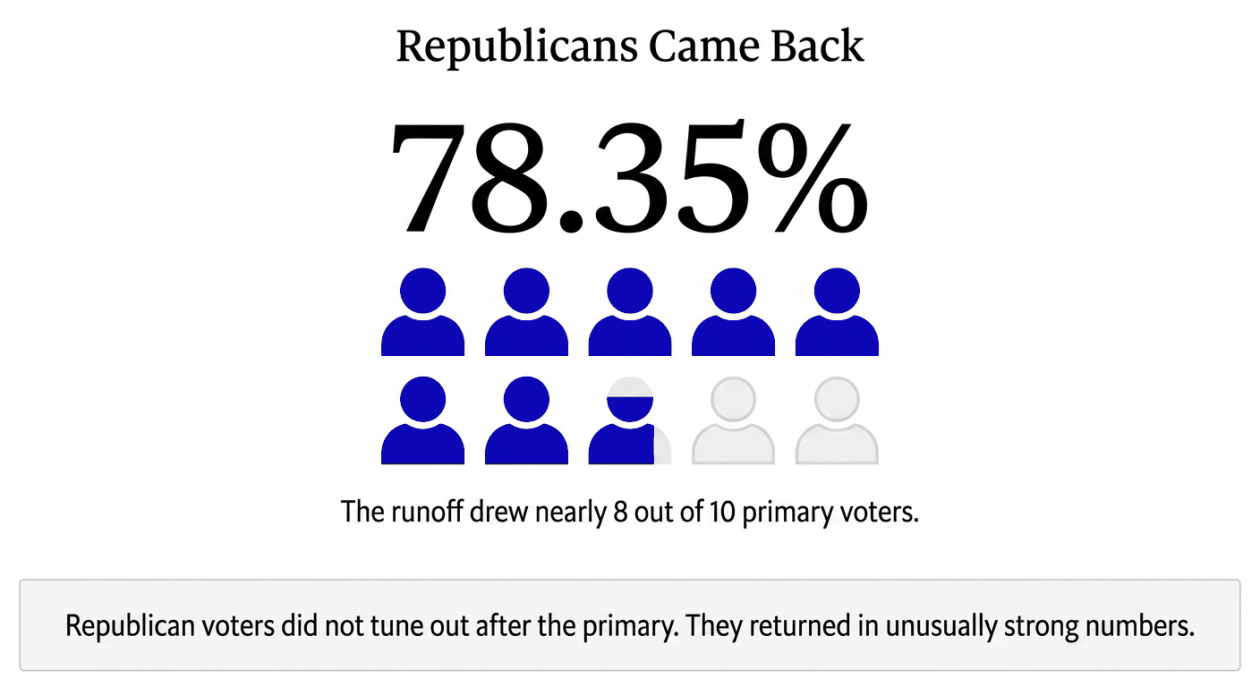
Our model let runoff turnout climb to 65% of the primary at most — a generous ceiling by the standards of Georgia runoffs. Actual retention was 78.35%. We did not miss the number by a little; we misjudged how much appetite Republican voters had to come back. That is good news for November; being surprised by enthusiasm beats being surprised by apathy!
The field consolidated instead of splitting.
Our three-bloc framework — Experience, Combat, and Swing — treated the King, Sterling, and Metz voters as a contested pool that would divide between the finalists. In the returns, it did not look divided. It consolidated overwhelmingly around Fleming. We modeled a persuasion fight — the runoff delivered a rout.
Jones hit a ceiling.
Jones added just 4,463 votes to his primary total. Whatever voters liked about his message, his coalition did not expand in the runoff. That may reflect concerns about experience, party history, electability, or simply the limits of his appeal — but the result is clear: he held his base and little more.
|
| |
|
|
|
Why the Office Matters Now
Change Runs Through This Office
|
|
|
|
|
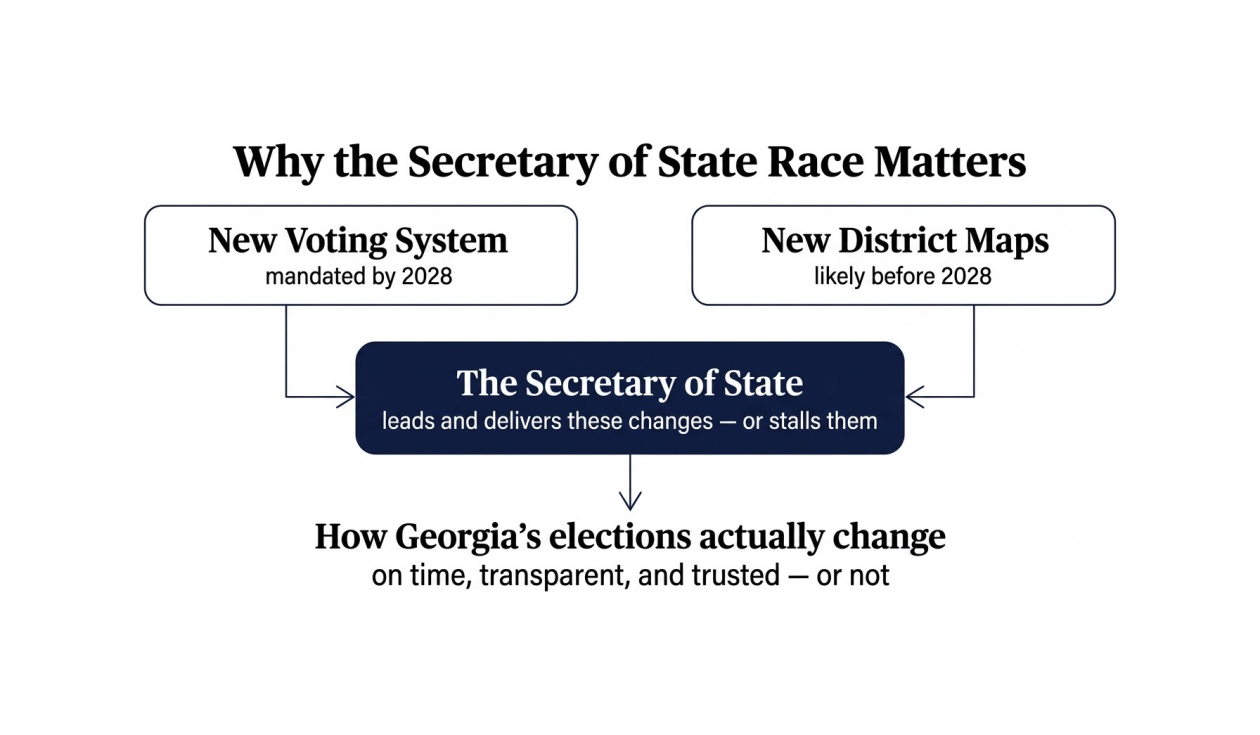
Georgia’s elections are heading into their biggest changes in years: a new voting system, and likely new maps. Both will be led, or stalled, by a single office. This race matters not because the job gained power this summer, but because a law is only as good as the officeholder who carries it out.
|
| |
|
|
|
A statute is only as good as the office that runs it.
In 2024, the legislature ordered Georgia to stop counting ballots with QR codes by July 1, 2026. That deadline arrived with no replacement system in place, forcing June’s special session to push it to January 1, 2028. The lesson is the whole point: the Assembly can pass a law, but only a willing and effective Secretary of State can carry it out. The next officeholder inherits a bigger version of that task, introducing a brand-new voting system and running every election that depends on it. The same special session also mandated automatic hand recounts in any statewide race decided by under half a percent, making Georgia the 29th state to require them.
The next Secretary will run elections under maps still being drawn.
The special session also declined, for now, to redraw Georgia’s districts. In Louisiana v. Callais, the Supreme Court held that states cannot draw districts primarily by race to satisfy a racial target — giving states more room to revisit maps that had looked settled. Georgia chose to wait, leaving room to act before 2028, on the next Secretary’s watch.
With no federal backstop, mail-in ballot rules are Georgia’s to set.
In Watson v. Republican National Committee, decided June 29, the Supreme Court left the deadline for receiving mail ballots to the states. Currently, Georgia’s rule is strong: absentee ballots must be received by 7 p.m. on Election Day. California shows the alternative — late-arriving ballots, extended counting, and public uncertainty.
The opponent is set.
Fleming’s opponent is Penny Brown Reynolds, who won the Democratic runoff. Between now and November we’ll introduce Reynolds and sharpen the contrast as the campaign unfolds.
|
| |
|
|
|
The Bottom Line
June Was the Warm-Up
|
|
|
|
|
The base showed up in June. June is not November: a runoff electorate of 667,000 is a fraction of the several million Georgians who will vote in the general, and enthusiasm does not carry itself. The base showed up once. Now it has to show up again — and bring others with it.
|
| |
|
|
|
Sources
- Georgia Secretary of State, certified results: May 19 general primary and June 16 primary runoff.
- Senate Bill 3EX, 2026 special session (QR-code deadline moved to January 1, 2028; legislative committee to recommend a replacement; automatic hand recounts in statewide races under 0.5%; redistricting deferred): Ballotpedia News.
- Louisiana v. Callais, 608 U.S. ___ (2026), decided April 29, 2026: SCOTUSblog.
- Watson v. Republican National Committee, 609 U.S. ___ (2026), decided June 29, 2026: SCOTUSblog.
- Georgia absentee ballot deadline, received by 7 p.m. on Election Day: Georgia.gov.
- June 2026 Election Integrity News: read the issue.
|
| |
|
|
|
|
|